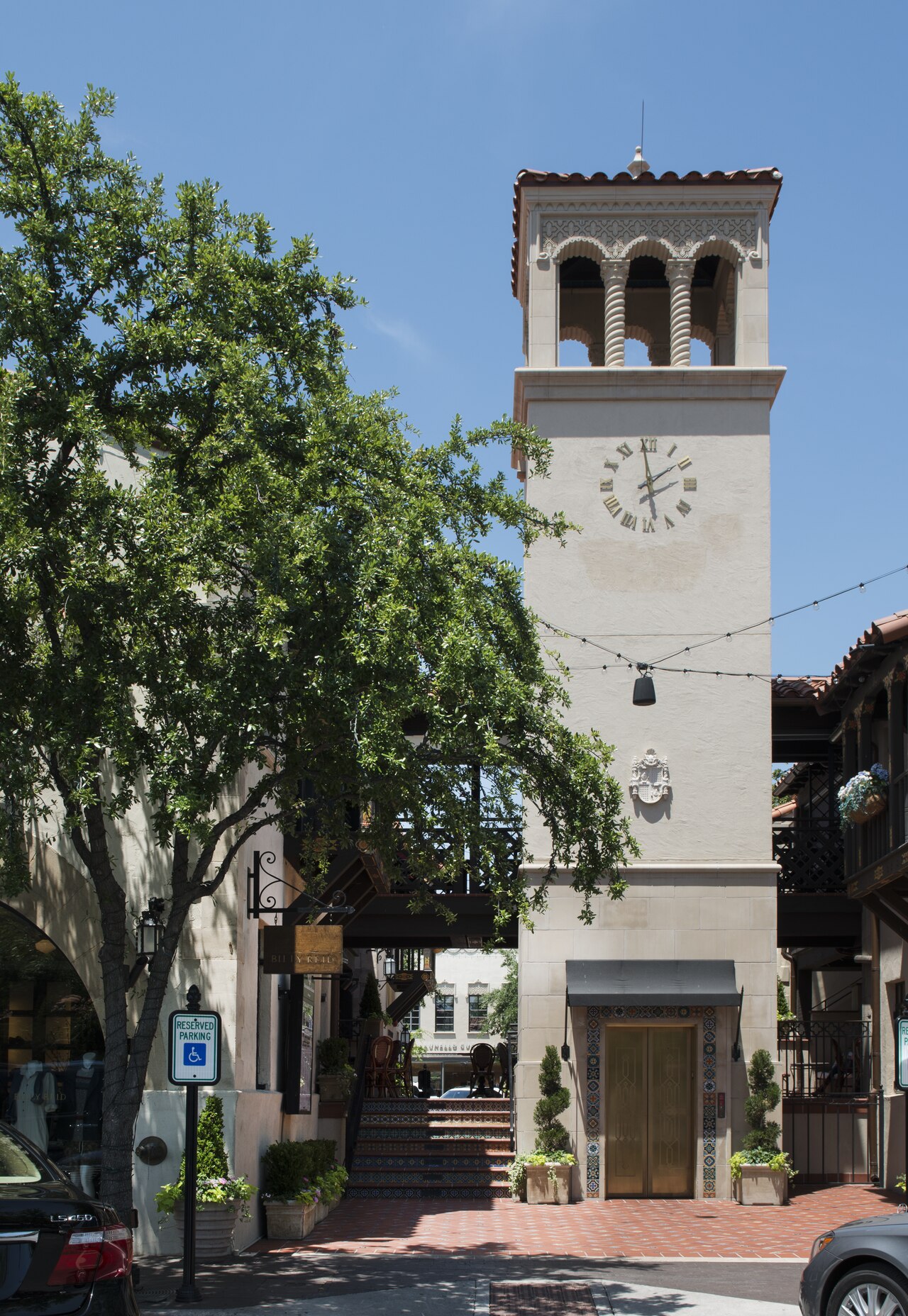
Clock tower and storefronts at Highland Park Village shopping center in Dallas. Photo: Carol M. Highsmith, Library of Congress, via Wikimedia Commons. License: Public domain.
Quick Answer: North Texas cities received sharply higher sales tax payments from the Texas Comptroller in November 2026. Dallas got $42.6 million, up 6.6% from November 2025, while Fort Worth’s $28.0 million was up 22.4% and Frisco’s $15.0 million was up 22.3%. Statewide, city allocations rose 13.3%, with the state reporting the biggest gains in business-driven sectors such as construction and manufacturing.
For Texas cities, sales tax arrives every month as a check from the Texas Comptroller of Public Accounts. Because it tracks what people and businesses buy, it is also one of the fastest-moving local economic indicators available. The November 2026 allocations, deposited into local accounts on November 16, show that spending tied to Dallas-Fort Worth cities remained strong heading into the end of the year.
This analysis uses the Comptroller’s city sales tax allocation comparison data for 14 large Dallas-Fort Worth cities, along with the Comptroller’s November 2026 press releases on statewide state and local collections.
How much sales tax did DFW cities receive in November 2026?
The 14 cities in this analysis received a combined $191.5 million in November 2026, compared with $160.2 million in November 2025, an increase of 19.5%. That figure is inflated by unusually large payments to Denton and Irving and a sharp drop in Garland, discussed below. Excluding those three cities, the remaining 11 cities’ allocations rose 12.6%, close to the statewide city increase of 13.3%.
| City | City rate | Nov. 2026 | Nov. 2025 | Change |
|---|---|---|---|---|
| Dallas | 1% | $42.56M | $39.92M | +6.6% |
| Fort Worth | 1% | $27.96M | $22.84M | +22.4% |
| Arlington | 2% | $18.82M | $17.35M | +8.4% |
| Denton | 1.5% | $16.58M | $4.93M | +236.6% |
| Irving | 1% | $15.31M | $9.51M | +61.1% |
| Frisco | 2% | $15.03M | $12.29M | +22.3% |
| Plano | 1% | $13.03M | $11.21M | +16.2% |
| McKinney | 2% | $10.25M | $8.75M | +17.1% |
| Grapevine | 1.5% | $6.19M | $5.73M | +8.1% |
| Allen | 2% | $5.78M | $5.40M | +7.0% |
| Richardson | 1% | $5.74M | $4.94M | +16.2% |
| Lewisville | 1.25% | $5.42M | $5.22M | +3.8% |
| Carrollton | 1% | $4.91M | $4.55M | +7.9% |
| Garland | 1% | $3.88M | $7.54M | -48.6% |
Source: Texas Comptroller of Public Accounts, Sales Tax Allocation City Comparison Summary, November 2026 report. Net payments after the state’s service fee and retainage.
What period of sales does the November allocation cover?
According to the Comptroller’s distribution schedule, the November 2026 payment reflects September monthly returns and third-quarter returns, which were due October 20, 2026. The Comptroller’s November 13 release said the allocations come mainly from monthly filers reporting September sales and from quarterly filers. In short, the November checks largely reflect spending in July, August and September.
That quarterly component makes November one of four heavier months each year, along with February, May and August. The pattern is visible in Dallas’ own figures: the city received $48.4 million in February, $42.4 million in May, $43.5 million in August and $42.6 million in November, compared with $33.7 million to $38.8 million in most other months of 2026. Year-over-year comparisons, which match the same month in each year, are the most reliable way to read the data.
How did Texas sales tax perform statewide in fall 2026?
The Comptroller distributed $1.4 billion in local sales tax allocations in November 2026, up 14.6% from November 2025, according to its November 13 release. Cities received $902.7 million, up 13.3%. Transit systems, which include Dallas Area Rapid Transit and other agencies, received $301.1 million, up 16.1%.
| Recipient (statewide) | Nov. 2026 allocation | Change from Nov. 2025 | Year-to-date change |
|---|---|---|---|
| Cities | $902.7M | +13.3% | +7.4% |
| Transit systems | $301.1M | +16.1% | +8.1% |
| Counties | $88.3M | +15.6% | +8.9% |
| Special purpose districts | $153.2M | +19.3% | +11.2% |
| Total | $1.4B | +14.6% | +8.0% |
Source: Texas Comptroller of Public Accounts, November 2026 local sales tax allocations release.
The state side tells a similar story. The Comptroller reported on November 2 that net state sales tax revenue for October 2026 totaled $4.8 billion, up 13.3% from October 2025, and that calendar year-to-date state sales tax revenue was $44.4 billion, up 8.4%.
What is driving the sales tax increase in Texas?
The Comptroller attributed the strongest gains to business spending rather than household shopping. In its October revenue release, the agency said remittances from sectors driven primarily by business spending showed the largest increases. Collections from construction rose 38% and manufacturing rose 33% compared with October 2025, and the Comptroller said those gains may reflect investment in large-scale projects, including data centers, in September.
Retail trade, the largest sector, was up 11%, driven mainly by electronics and appliance stores and online shopping, according to the Comptroller. Restaurant collections rose only 2.3%, which the agency noted was below the inflation rate for food away from home. Collections from oil and gas mining fell nearly 12%.
That mix helps explain why some DFW cities are seeing much bigger gains than others. Because business purchases of taxable equipment and materials count alongside consumer goods, so a city where a large company is building or equipping a facility can see allocations jump even if local shoppers are spending at a normal pace.
Why did Denton, Irving and Garland post such large swings?
Single-month changes of 50% or more usually reflect something other than ordinary retail growth. The Comptroller’s description of allocation components notes that a monthly payment can include prior-period collections from amended or late returns, audit collections and future collections, in addition to taxes from the current period. The agency also says allocation amounts depend on the timing and accuracy of taxpayers’ returns.
Denton
Denton’s November allocation of $16.6 million was more than three times its November 2025 payment of $4.9 million. The increase did not come out of nowhere: Denton’s allocations were up 61.5% in August, 41.0% in September and 70.8% in October compared with a year earlier. Through November, the city has received $73.1 million in 2026, up 42.5%, a calendar-year total that already exceeds the $62.9 million in sales tax the city had estimated for its entire 2025-26 fiscal year, according to an August KERA News report on Denton’s budget. That report noted Denton has two data centers and that state law provides significant sales tax exemptions for data centers. The Comptroller data does not identify which taxpayers drove the November payment.
Irving
Irving received $15.3 million in November, up 61.1% from $9.5 million a year earlier, after a 24.4% increase in October. Through November, Irving’s 2026 allocations total $122.4 million, up 13.7%, a strong but less dramatic pace.
Garland
Garland’s November payment of $3.9 million was down 48.6%, following a 55.7% drop in October. But Garland’s 2026 payments have been steady, ranging from about $3.0 million to $4.5 million each month. The decline reflects an unusually high base a year earlier: Garland received $8.2 million in October 2025 and $7.5 million in November 2025, roughly double its typical monthly level. Its year-to-date total of $41.5 million is down 15.7%.
How are the biggest DFW cities trending for all of 2026?
Year-to-date figures smooth out the monthly swings. Among the eight largest cities in this analysis, combined allocations from January through November 2026 total $1.44 billion, up 9.2% from the same months of 2025. That outpaces the 7.4% year-to-date increase for all Texas cities reported by the Comptroller, though Denton’s surge accounts for part of the difference.
| City | 2026 payments to date (Jan.-Nov.) | Same period 2025 | Change |
|---|---|---|---|
| Dallas | $432.5M | $413.7M | +4.5% |
| Fort Worth | $250.1M | $227.9M | +9.8% |
| Arlington | $195.2M | $177.9M | +9.7% |
| Frisco | $145.9M | $130.7M | +11.6% |
| Plano | $126.0M | $121.8M | +3.4% |
| Irving | $122.4M | $107.7M | +13.7% |
| McKinney | $97.3M | $90.4M | +7.6% |
| Denton | $73.1M | $51.3M | +42.5% |
Source: Texas Comptroller of Public Accounts, Sales Tax Allocation City Comparison Summary, November 2026 report.
Among smaller suburbs, Allen’s year-to-date allocations of $71.3 million are up 20.7% and Richardson’s $61.0 million is up 19.0%. Lewisville is up 8.8%, Grapevine 5.6% and Carrollton 1.6%.
Is Dallas falling behind its suburbs?
Dallas collects by far the most sales tax in the region, but its growth rate has trailed. Its 4.5% year-to-date gain is roughly half of Fort Worth’s and Arlington’s. Its month-by-month results were mixed early in the year, with declines from a year earlier in January (-4.2%) and May (-6.1%), before firming in the second half with gains of 12.8% in August, 10.4% in October and 6.6% in November.
Fort Worth, by contrast, posted double-digit year-over-year gains in six of the past eight months, including 18.0% in September and 22.4% in November. Plano’s pattern was uneven: its allocations fell from a year earlier in July, August and September before rising 15.6% in October and 16.2% in November.
Why do DFW city sales tax rates differ?
Texas levies a 6.25% state sales tax, and local governments, including cities, counties, special purpose districts and transit authorities, may add up to 2%, for a maximum combined rate of 8.25%, according to the Comptroller. How each city splits its local 2% shapes how much it receives directly.
Dallas, Plano, Irving, Garland, Richardson and Carrollton are member cities of Dallas Area Rapid Transit, which receives one cent of the local sales tax in those cities, as Mass Transit reported. That leaves those cities with a 1% city rate in the Comptroller’s data. Arlington, Frisco, McKinney and Allen, by contrast, collect a 2% city rate. That difference in rates is one reason Arlington receives about 45% as much city sales tax as Dallas does, and why comparisons of raw dollar amounts between cities can mislead. Percentage changes are the better yardstick.
What does strong sales tax growth mean for DFW city budgets?
Sales tax gains give cities room in their budgets, and they have become part of the state’s property tax debate. In his November 13 release, Comptroller Don Huffines said he hoped the Legislature would use these revenues to help reduce property taxes. In August, he argued that many local governments could dedicate much of their sales tax increases to property tax reduction.
For city finance officers, the November data carries a caution as well as good news. Large one-month swings tied to specific taxpayers, audits or filing timing can reverse, as Garland’s comparison with its unusually high 2025 payments shows. Year-to-date trends, rather than single months, are the better guide for budgeting.
Brian’s Take
What stands out to me is where the growth is coming from. The Comptroller says the biggest gains are in construction and manufacturing, not restaurants, where collections grew slower than food prices. That tells me North Texas sales tax strength right now leans heavily on businesses building and equipping things, which is great while it lasts but is lumpier than steady household spending.
The Denton and Garland numbers are the lesson. A city can see its check triple or get cut in half in a single month for reasons that have little to do with how its stores are doing. If I were looking at a city’s finances, I would focus on the year-to-date column. On that basis, Dallas at 4.5% is growing, but more slowly than Fort Worth, Arlington, Frisco and Irving, and that gap is worth watching.
The property tax angle matters too. When the state’s chief financial officer is publicly urging local governments to use sales tax gains for property tax relief, rising receipts become a political question, not just an accounting one.
Frequently Asked Questions
How much sales tax did Dallas receive in November 2026?
Dallas received a $42.56 million net allocation in November 2026, up 6.6% from $39.92 million in November 2025. Its 2026 total through November is $432.5 million, up 4.5%.
Which DFW city had the biggest sales tax increase in November 2026?
Among the 14 cities reviewed, Denton had the largest increase, at 236.6%, followed by Irving at 61.1%. Among the largest cities, Fort Worth (22.4%) and Frisco (22.3%) posted the biggest gains.
Why are Texas sales tax collections rising in 2026?
The Comptroller said the largest increases came from sectors driven by business spending. October collections from construction rose 38% and manufacturing 33%, possibly reflecting investment in large projects including data centers, while retail rose 11%.
When does the Texas Comptroller send sales tax to cities?
Monthly. The November 2026 payment was deposited November 16, and the December payment is scheduled for December 11, 2026, covering October returns.
Why did Garland’s sales tax fall in November 2026?
Garland’s November payment of $3.9 million was in line with its other 2026 months. The 48.6% decline reflects an unusually high $7.5 million payment in November 2025.
Sources and Further Reading
- Sales Tax Allocation City Comparison Summary, November and October 2026 reports — Texas Comptroller of Public Accounts
- Comptroller Huffines Distributes $1.4 Billion in Net Local Sales Tax Collected in October to Texas Communities — Texas Comptroller of Public Accounts
- Texas Comptroller Huffines Reports Net State Sales Tax Revenue Totaled $4.8 Billion in October — Texas Comptroller of Public Accounts
- Comptroller Huffines Distributes $1.4 Billion in Monthly Sales Tax Revenue to Local Governments, Calls for Property Tax Relief (August 2026) — Texas Comptroller of Public Accounts
- Local Sales Tax Allocation Components and Monthly Distribution Schedule — Texas Comptroller of Public Accounts
- Local Sales and Use Tax Frequently Asked Questions — Texas Comptroller of Public Accounts
- Denton Starts Planning Out $2.22B Budget With a Boost From Data Center Taxes — KERA News
- Who Pays for Public Transportation in North Texas? How DART Is Funded and Governed — Mass Transit